
Big models, fast, on the Tesla P100 and V100 cards everyone else stopped tuning for.
A llama.cpp-based engine with its own quant format (PXQN), MTP speculation, expert streaming for models bigger than the card, tensor split and hand-written Pascal and Volta kernels, and PXA Control, the app that runs it. Every number below is a ledger row.
Against a popular community fork, on its home turf
The fork is tuned for Pascal. We ran its own build, its own files and its README flags against ours, same box, same bracket. Every P100 cell is now ours, prompt reading included (the +23.2% at 16k is an opt-in lever set).
Qwen3.8-27B dense, 2x P100
- Ours: our P100 stack + PXQN4 (15.72 GB)
- A popular community fork
Qwen3.8-27B dense, 2x P100
- Ours: our P100 stack + PXQN4 (15.72 GB)
- A popular community fork
Qwen3.6-35B-A3B MoE + MTP, 2x P100
- Ours: our PXQN4 file + MTP verify kernels (e2d9d0af4b)
- A popular community fork
Qwen3.6-35B-A3B MoE prompt reading, 2x P100
- Ours: opt-in long-prefill set: PXA_PF_STABLE_SHAPE + PXA_FA_TILE_H2CHUNK + PXA_FA_LONGPREFILL=3 (d33552b144)
- A popular community fork
4.0 against v3.1, same box
Numbers are from the development branches that become 4.0 (the integration branch), not from a published build. Cells measured on a busy box say so; the Speed page has the row ids, brackets and method for each.
| Cell | Classes | Ours | Baseline | Change | Status |
|---|---|---|---|---|---|
| V100 1x Overdrive1x Tesla V100 16 GB | prose / code | 38.77 / 47.47 | 32.42 / 36.08 | prose +19.5% · code +31.5% | candidate |
| V100 27B MTP1x Tesla V100 16 GB | prose / code | 62.43 / 84.38 | 59.50 / 65.45 | prose +4.9% · code +28.9% | gated, opt-in |
| V100 27B plain decode1x Tesla V100 16 GB | prose / code | 41.81 / 41.82 | two steps | prose +2.9% · code +3.2% | default on |
| P100 27B1x Tesla P100 16 GB | prose / code | 27.77 / 27.83 | 25.61 / 25.62 | prose +8.4% · code +8.6% | opt-in |
| 2x P100 27B tensor split2x Tesla P100 16 GB | prose / code | 38.0 / 38.04 | 25.74 / 25.76 | prose +47.6% · code +47.6% | default on |
| P100 MoE 35B-A3B MTP2x Tesla P100 16 GB | greedy / sampled | 138.11 / 131.2 | 99.59 / 96.42 | greedy +38.6% · sampled +36.0% | gated |
| 2x Overdrive2x Tesla V100 16 GB | prose / code | 63.31 / 74.37 | 59.05 / 70.22 | prose +7.2% · code +5.9% | default on |
| 2x P100 Overdrive2x Tesla P100 16 GB | prose / code / pp8k / pp16k / pp30k | 40.94 / 47.29 / 300.0 / 290.0 / 267.0 | 38.11 / 44.88 / 250.0 / 235.0 / 208.0 | prose +7.4% · code +5.3% · pp8k +20.0% · pp16k +23.4% · pp30k +28.3% | default on |
| Flash-Next 28k prefill1x Tesla V100 16 GB | pp28k | 597.3 | 324.3 | pp28k +84.1% | default on |
| P100 27B MTPP100 | – | – | – | – | no number yet |
| GLM6-7 cards | – | – | – | – | no number yet |
Where the time went
Hover or tap a bar for its ledger row. Each chart has its own axis; decode and prompt reading never share one.
2x P100 27B tensor split
- Ours: -sm tensor (auto pick)
- Baseline: -sm layer, same binary
P100 MoE 35B-A3B MTP
- Ours: multi-token MoE verify kernels + verify-width levers
- Baseline: our 10-14 stack (c919fc1afb, base recipe)
- A popular community fork
Flash-Next 28k prefill
- Ours: PXA_AUTO_UB_STREAM: -ub 4096 when experts stream
- Baseline: same server, today's automatic -ub 2048
V100 27B MTP
- Ours: MTP n_max 4, p_min 0.5, exact verify GEMM (PXA_PXQN_QPN=1)
- Baseline: shipping MTP ramp (depth 1 below 8k), same engine
2x Overdrive
- Ours: -sm layer + HC_FUSED, det recipe E, MTP n_max 3
- Baseline: same server, HC_FUSED off
V100 1x Overdrive
- Ours: det recipe E + MTP n_max 3, p_min 0.75
- Baseline: shipping 1x preset as-is (preset A)
What ships today, and what 4.0 adds
The full list, including the opt-in levers and what is still in progress →
PXQN quants with measured quality classes
Every tier carries a measured KL class on Qwen3.8-27B: PXQN2 behaves like a classic 3-bit file at 2-bit size (9.6 GB, KL 0.161); PXQN4 is 6-bit class in 15.7 GB (KL 0.0079); PXQN5 matches Q6_K (0.0022 vs 0.0023) in 84% of the space.
Kernels written for sm_60, sm_61 and sm_70
P100, GTX 1080 Ti / P40 and V100 get their own decode, verify and attention paths, using the instructions these chips really have.
Settings measured per card and model
Split mode, batch sizes, context, flash attention, speculation and KV type come from one measured table. Every choice prints at boot as a PXA_REGISTRY line; a flag you type always wins.
MTP and n-gram speculation, chosen per model
A file with an MTP head uses it where it pays; others get the n-gram drafter. Sampled drafts are accepted with the lossless rule, so the output distribution is the model's own.
Tensor split with a fused all-reduce
Two identical P100s or V100s (or four P100s) split every layer; the residual add, the two-card sum and the next norm run in one launch per card. Falls back to the layer split instead of stopping.
Expert cache for MoE files bigger than the card
Hot experts stay on the card, cold ones run from system RAM on a PXQN CPU matmul; the server profiles the routing once and can learn a better map per session. This is how a 32 GB Flash-Next file runs on one 16 GB card.
Flash-Next Overdrive on one P100
A measured preset: 26.91 to 30.70 t/s prose and 32.28 to 37.96 code (+14% / +18%).
Long context on one card
Checkpoint budgeting lets a 27B fit 131k context on one 16 GB card; a needle test at 125,000 tokens passes on one P100 and one V100.
Gemma 4 26B-A4B with its drafter
144.9 / 155.6 t/s prose / code on one V100 with the assistant drafter (-md).
Hot model swap
Register several models; they wait in pinned host RAM and the request's model field picks which one is on the cards (Volta and newer).
Runs on old CPUs
No AVX2? The launchers pick a compatibility library on their own; card speed is unchanged.
One tarball, one container, one updater
The tarball carries its own CUDA 12.8 runtime; ghcr.io/poisonxa16/pxa:v3.1 carries the same binaries; pxa-update apply / rollback switches versions and keeps your models.
Your rig, one click from serving
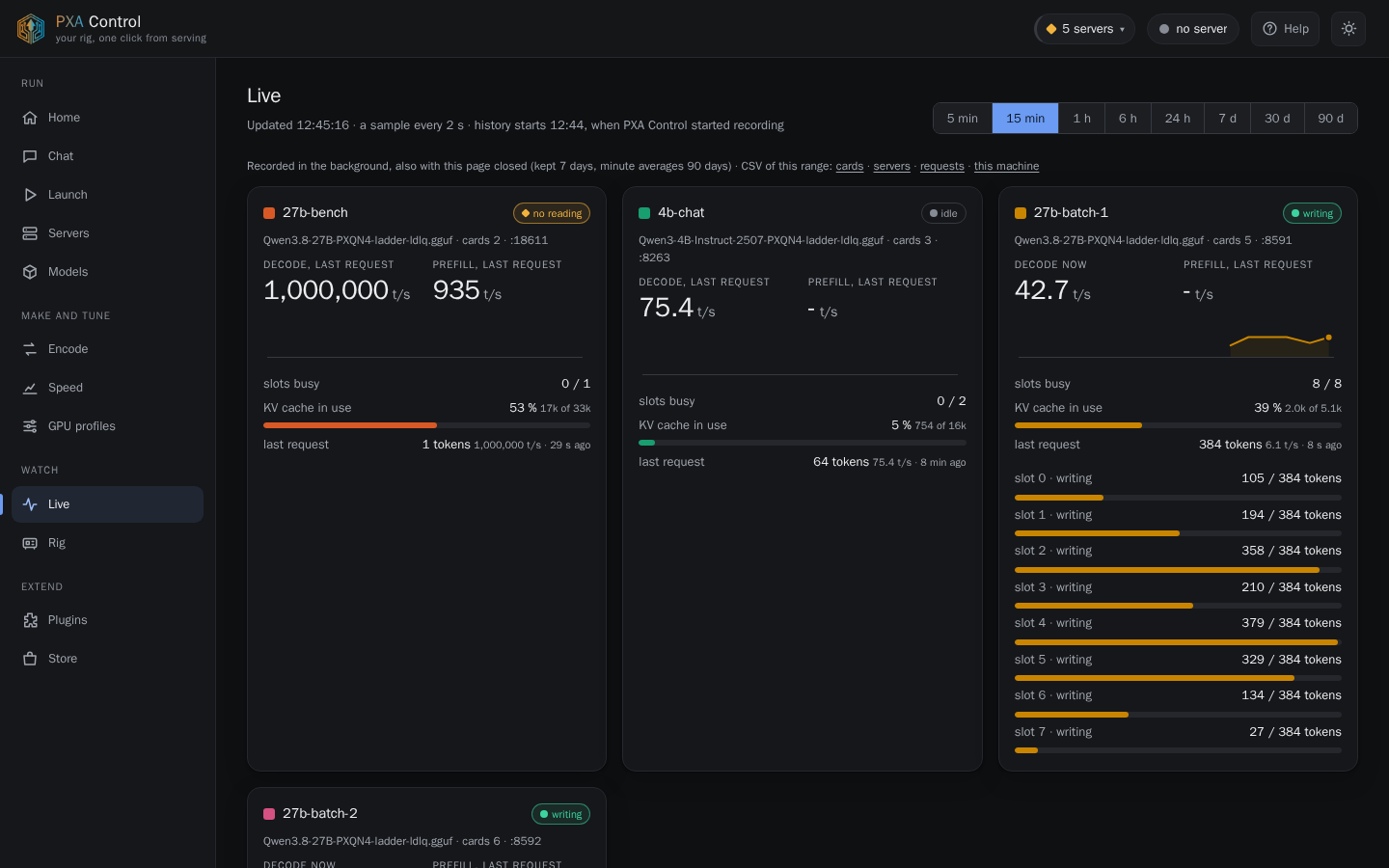
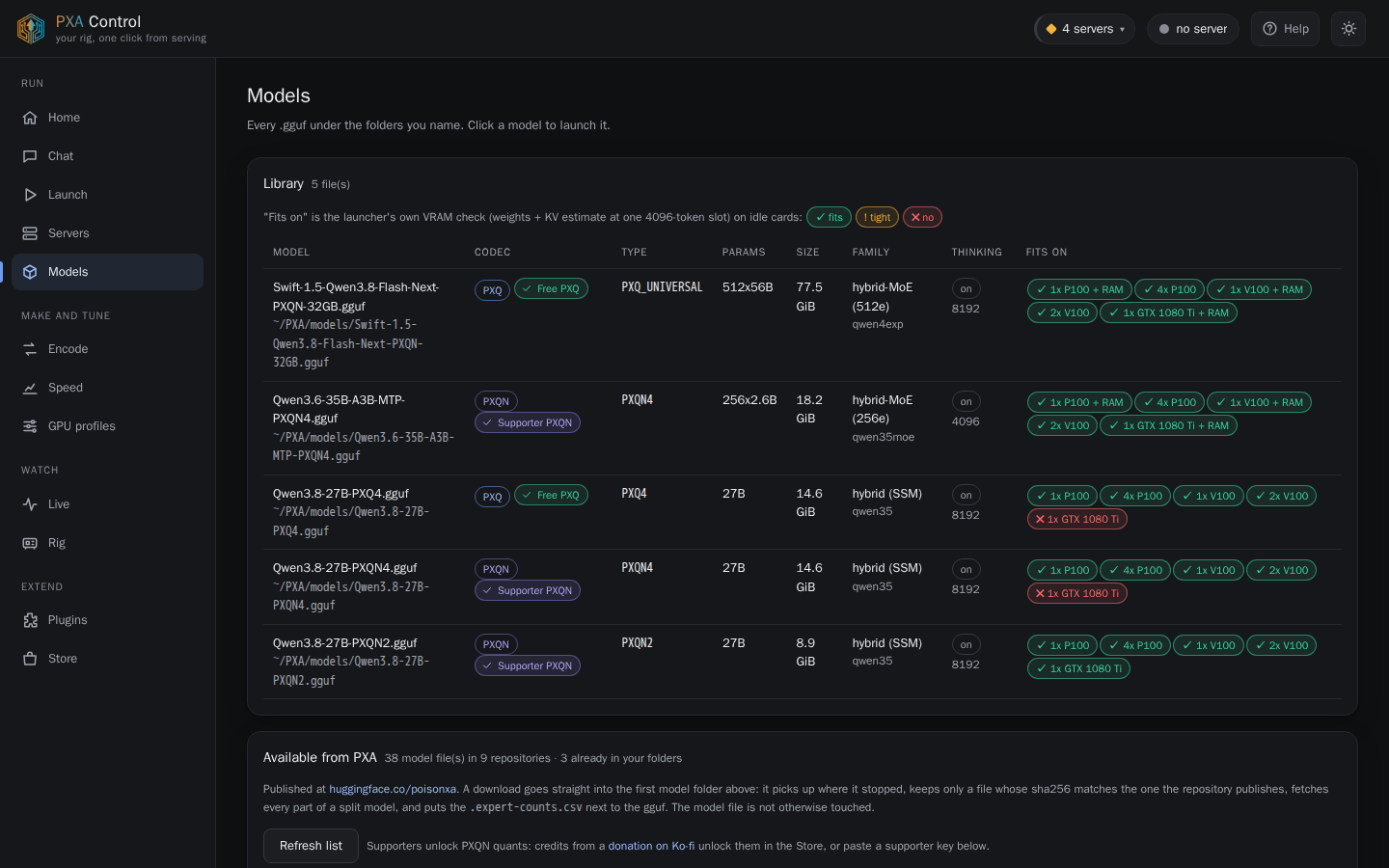
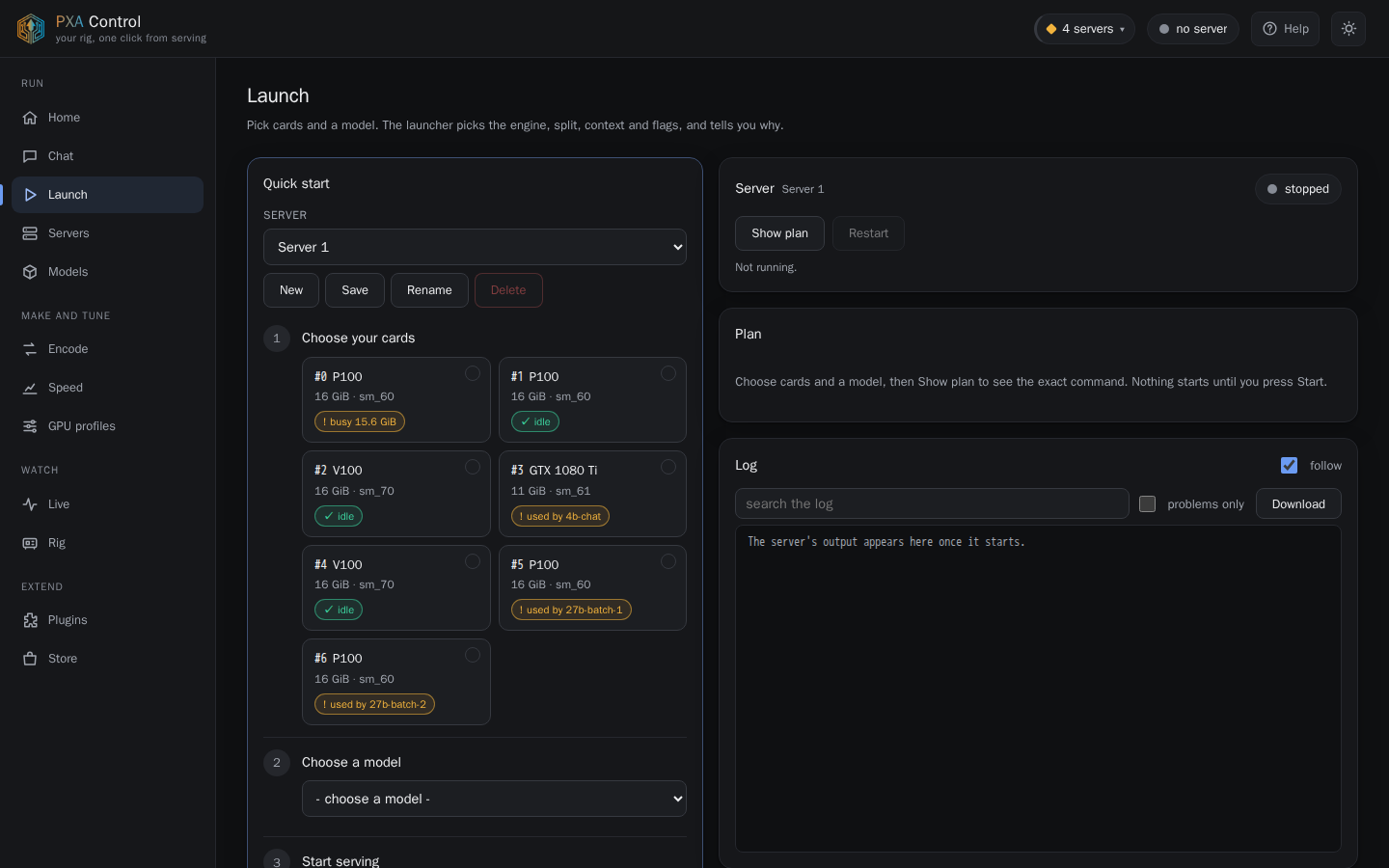
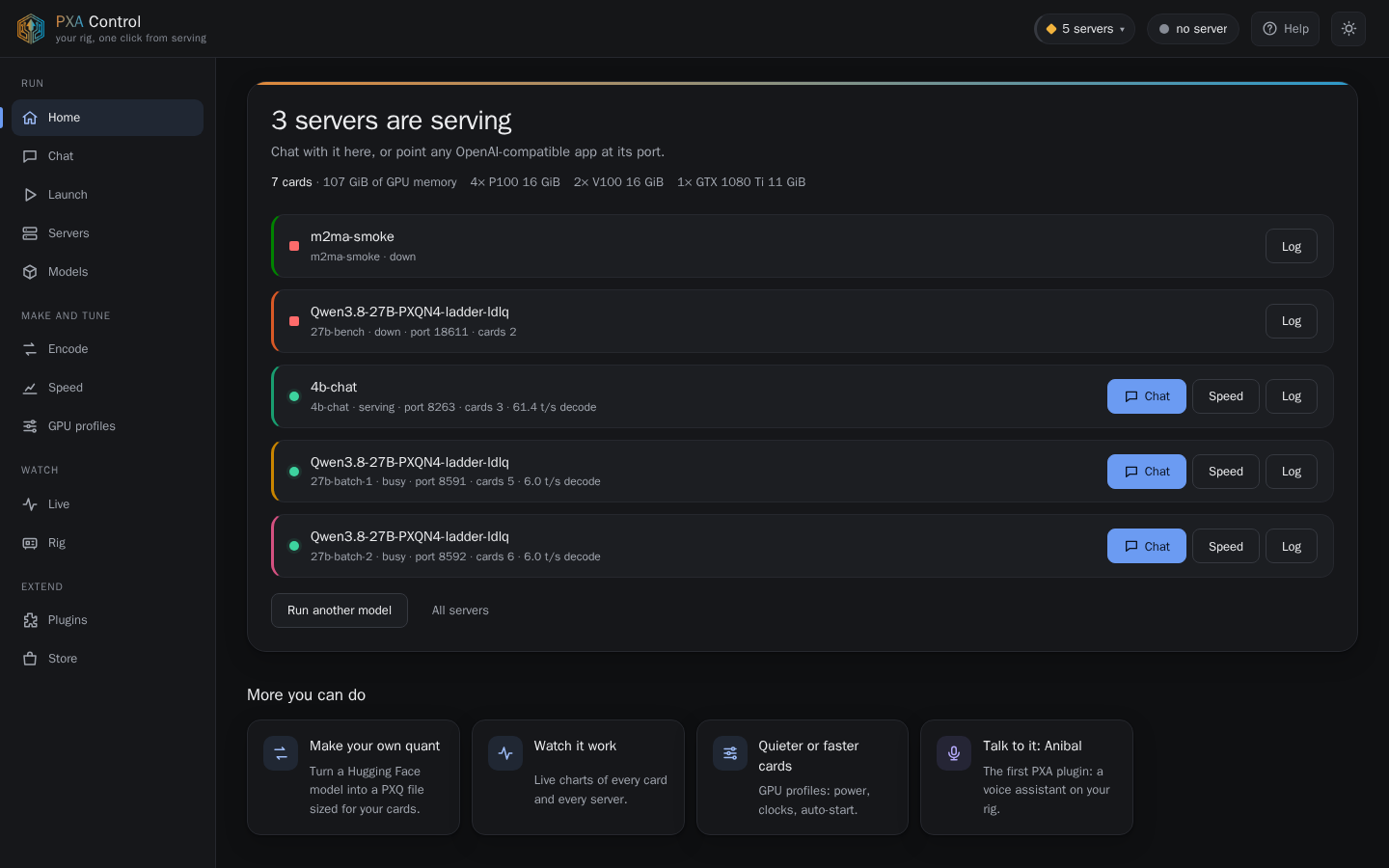
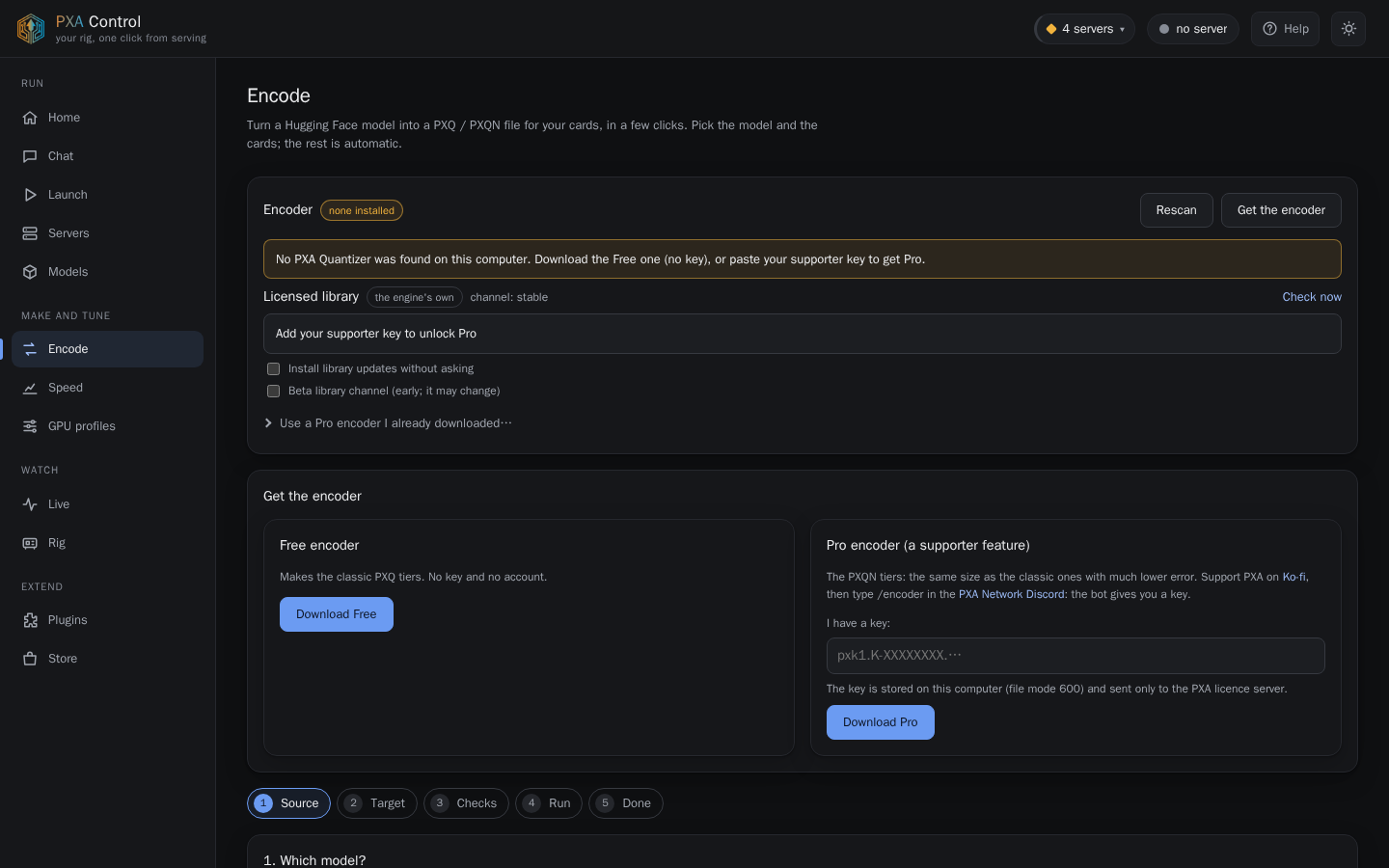
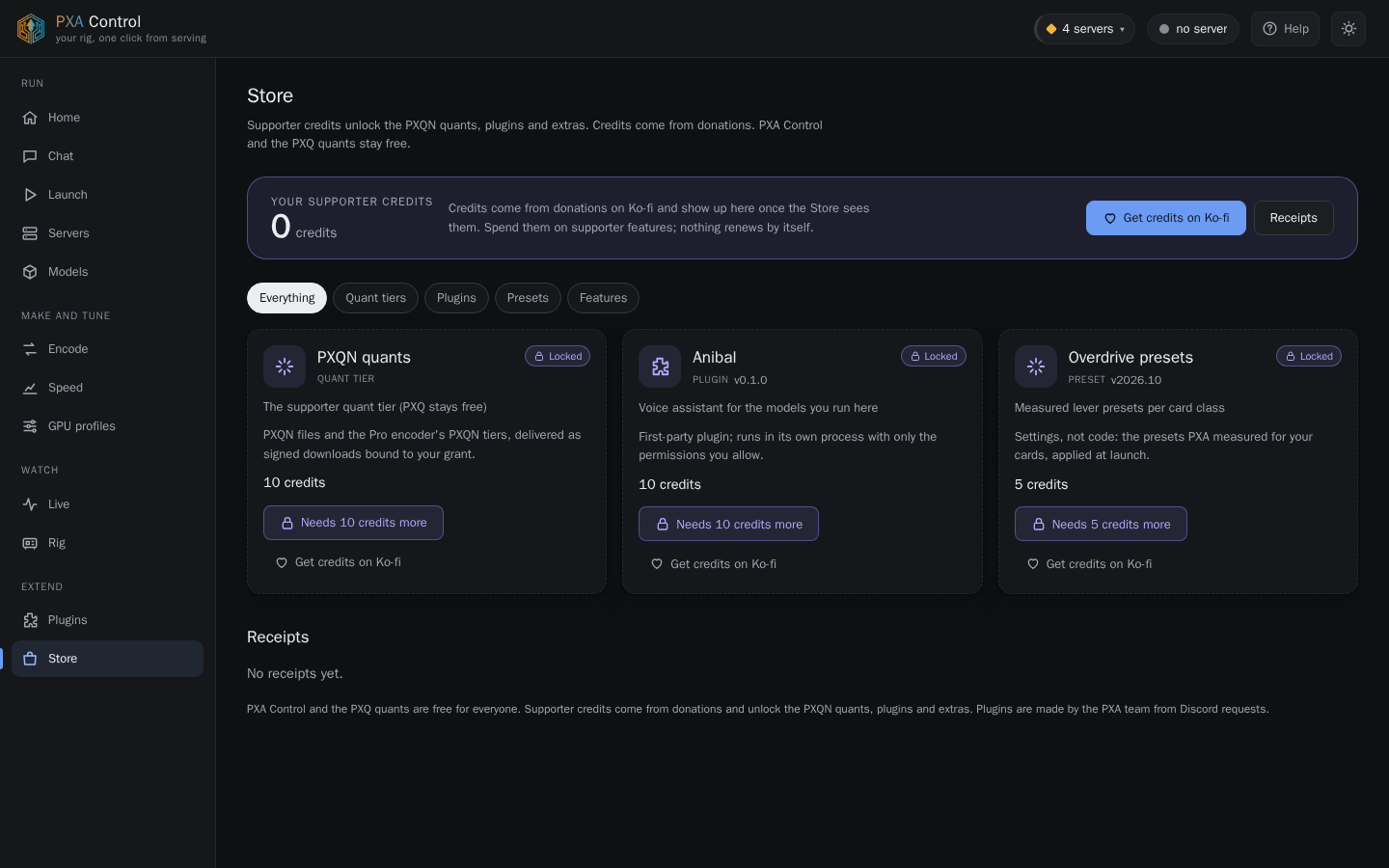
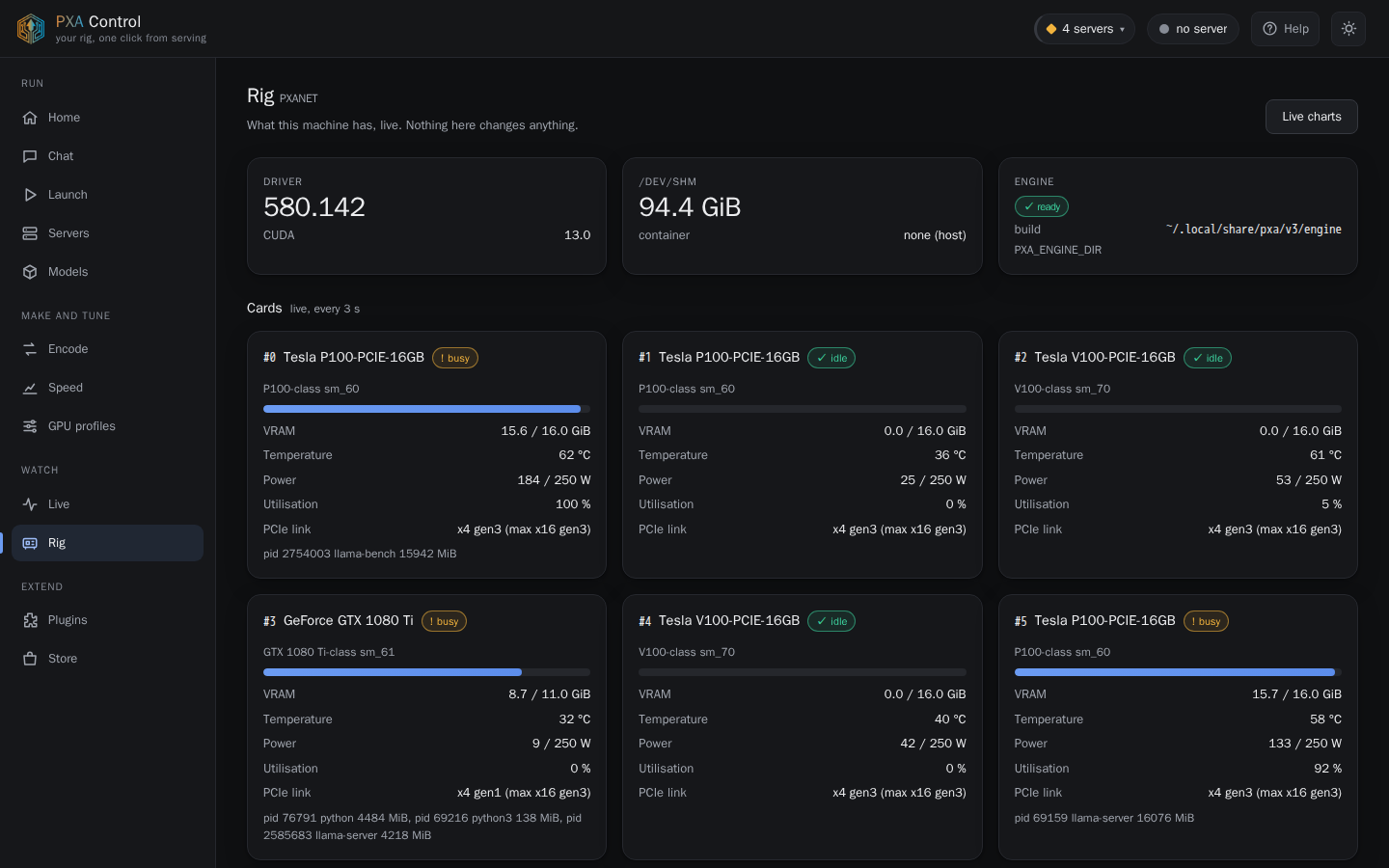
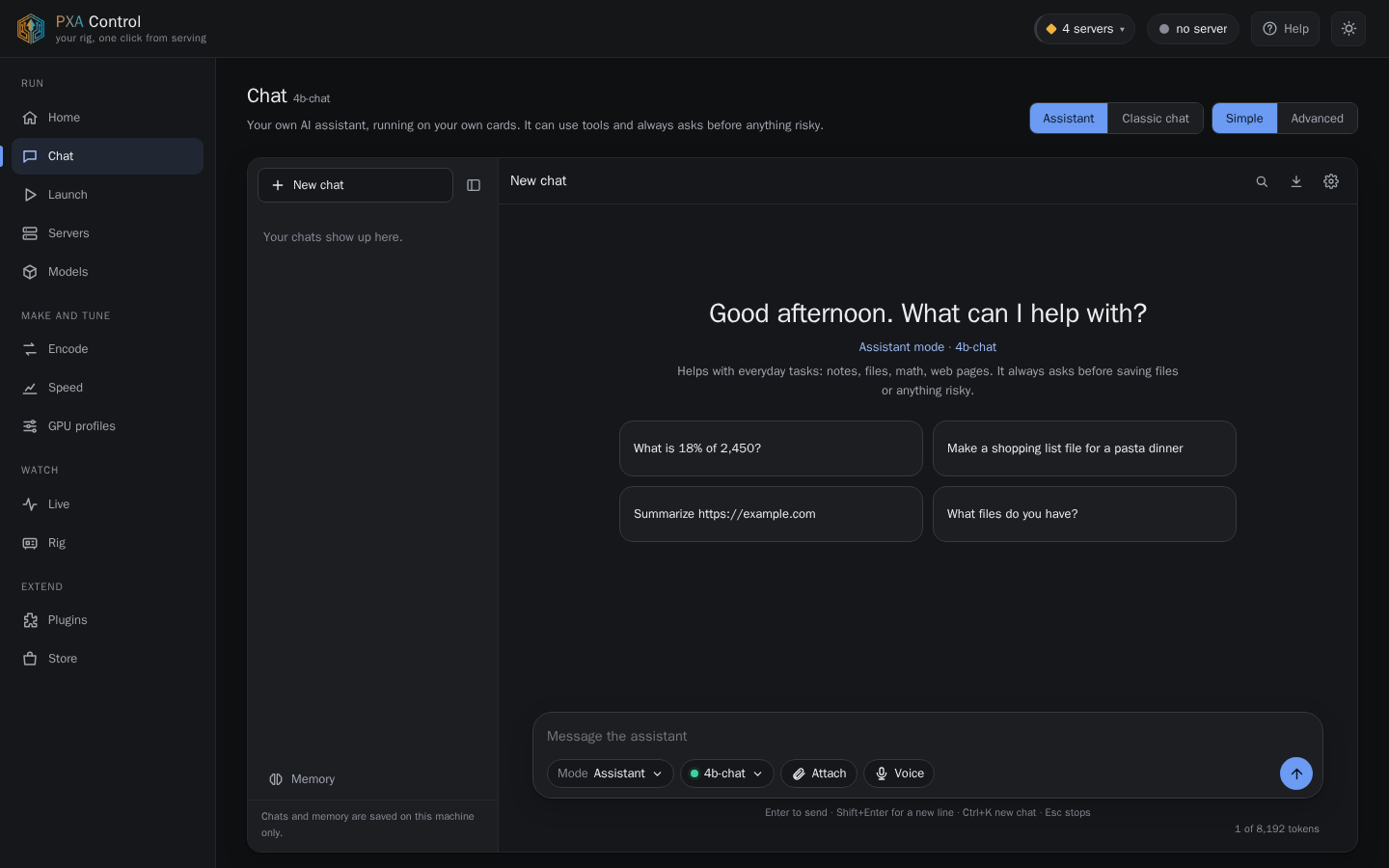
The browser app that finds your cards, reads your models, launches a server with measured settings and shows you every token per second. Real captures from the test box; the theme follows yours.
Where it runs
The engine needs NVIDIA Pascal or Volta cards on Linux. Control also runs on machines without them and drives your rig over the network.
Linux x86_64
Engine + PXA Control tarball (CUDA 12.8 runtime inside, sm_60/61/70), Ubuntu 24.04 and a 22.04 variant
v3.1 · get it
Linux one-file installer
pxa-<version>-linux-x86_64.run: verifies its own sha256, unpacks once, adds a menu entry, opens Control signed in
4.0-pre build (file name still says v3.2pre)
Windows x64
PXA Control .exe (tray app) + engine zip
4.0-pre build (file name still says v3.2pre)
macOS (Intel)
PXA Control as one file; drives a rig on your network (no CUDA on a Mac)
4.0-pre build (file name still says v3.2pre)
Android
PXA Control as an installable PWA and a small APK wrapper for your rig on the LAN
4.0-pre build (file name still says v3.2pre)
Free to run. Supporters unlock the PXQN tier.
Free
- The engine and PXA Control
- Classic PXQ quants and the Free encoder
- Standard GGUF files
Supporter Ko-fi
- PXQN quants and the Pro encoder key (
/encoderon the Discord) - Store credits for plugins and the measured Overdrive presets
- The #supporters channel
Valued Supporter
- Everything above, early access and roadmap votes
- One custom quant request a month, licence permitting
- Your name in the release notes
Credits come from Ko-fi and show up in PXA Control's Store tab. The engine is MIT-licensed; the PXQN kernels ship compiled.
Links
Discord
Help in #support, new quants in #models, releases in #announcements.
discord.pxanetwork.com
Ko-fi
Memberships fund the quantization runs, the testing and the releases.
ko-fi.com/shatteredrealms1
Hugging Face
PXQ and PXQN model files; who may download each is set on its model card.
huggingface.co/poisonxa
Live leaderboard
Every measured card setup, plus community scores sent from PXA Control.
benchmarks.pxanetwork.com
GitHub releases
Tarballs, the one-line installer and the release notes.
github.com/poisonxa16/pxa/releases/latest
Container image
ghcr.io/poisonxa16/pxa:v3.1, the same binaries.
github.com/poisonxa16/pxa/pkgs/container/pxa
Questions
Which cards does it run on?
Tesla P100 (sm_60) and Tesla V100 (sm_70) are tuned and measured; GTX 1080 Ti and other Pascal sm_61 cards work. RTX 20-series and newer are not in this build.
Do I have to use PXA quants?
No. Standard GGUF files (Q4_K_M, Q8_0 and the rest) load and run on the same server. The speed work targets PXQ and PXQN files, so use a PXA quant when a model has one.
Where do the numbers come from?
Every number on this site is a row in our speed ledger, measured on one box with four P100s and two V100s on PCIe gen3 x4. The Speed page names the row id, the date, the bracket and the method for each one.
Why is my output different from the last version?
New kernels add numbers in a different order, which can flip a near-tie between two words. Our quality test scores the same; every speed lever here is either bit-identical or listed as opt-in.
Do I need NVLink?
No. Plain PCIe works; the engine tests peer copies at start and falls back to a safe route on boards where they misbehave.
What does it cost?
The engine, PXA Control and the classic PXQ quants are free. Supporter credits from Ko-fi unlock the PXQN quants, plugins and Overdrive presets in the Store tab.
Is anything sent off my machine?
No telemetry. The engine runs locally with an OpenAI-style API. Control's benchmark upload and problem reports send only when you press the button, and show the payload first.